

Printing Paper Market on Course to Reach $457.5 Billion by 2035 as Packaging Replaces Publishing as the Growth Engine
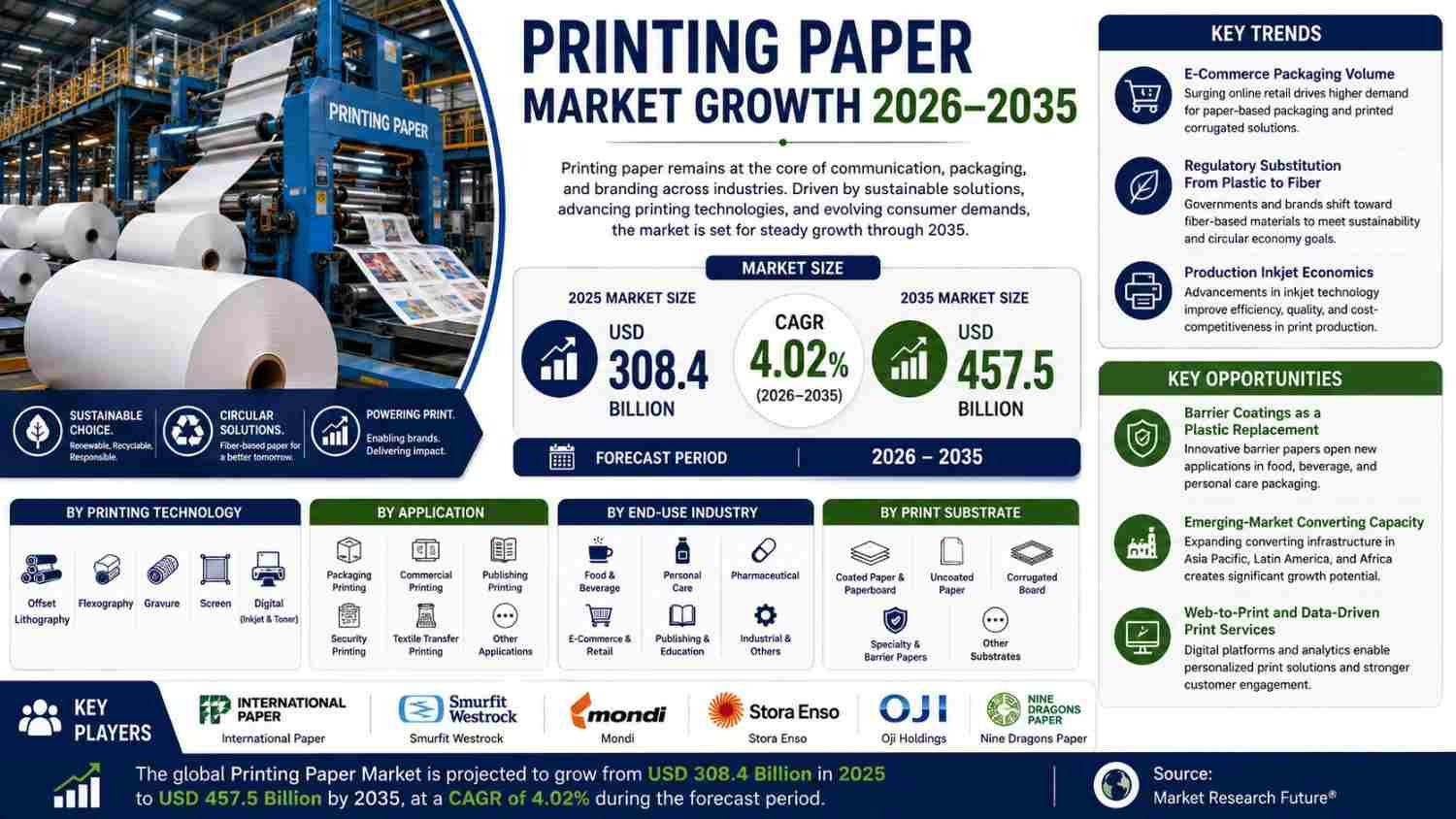
Printing Paper Market (2026 - 2035)
The Asia-Pacific region is responsible for 41.2% of 2025 revenue and has the fastest compound annual growth rate (CAGR) of 6.2% through 2035
NJ, UNITED STATES, August 19, 2026 /EINPresswire.com/ -- The global printing paper market is navigating one of the most profound demand transitions in its modern history. Valued at an estimated $308.4 billion in 2025, the market is projected to grow from $320.8 billion in 2026 to approximately $457.5 billion by 2035, registering a compound annual growth rate of 4.02%. While the headline growth rate appears modest, the underlying story is one of radical mix shift: publishing and commercial print segments are contracting under digital substitution pressure, while packaging, security printing, and specialty substrates are expanding fast enough to more than compensate, creating a larger but fundamentally different market than the one that existed a decade ago.The Great Reclassification: From Publishing Commodity to Packaging Platform
The paper passing through modern presses is no longer primarily destined for books, newspapers, and office copiers. Instead, it is increasingly being reclassified as a packaging substrate, a security document, or a branded e-commerce touchpoint. Global parcel shipments crossed 190 billion units in 2024, and each incremental parcel consumes corrugated board that is now printed rather than left plain. Brands have begun treating the shipping box as owned media, converting what was once a commodity substrate into a graphics purchase that commands premium pricing. This reclassification is the single largest revenue lever in the printing paper market and insulates converters from the secular decline in newsprint and directory work.
On the technology front, sheetfed offset lines constructed in the 2000s are being retired in favor of high-speed inkjet webs that eliminate plate-making, reduce makeready waste by 30 to 40%, and make short-run economics viable. The printing paper market is absorbing this transition through mix shift rather than volume collapse, as global shipments of production inkjet equipment absorbed an estimated $4.6 billion of capital spending in 2024 alone.
Market Size and Forecast Trajectory
Market Research Future's estimates combine mill-level shipment data from national pulp and paper associations, press installation registries, customs trade flows for coated and uncoated grades, and a bottom-up build of converter revenue across 41 countries. Historical figures from 2021 through 2024 are reconciled against company filings. The market has grown from $262.9 billion in 2021 and is expected to reach $347.1 billion by 2028 before climbing steadily toward the $457.5 billion endpoint in 2035.
Download Report Sample Copy: https://www.marketresearchfuture.com/sample_request/24140
Segment Analysis by Printing Technology
Offset lithography remains the workhorse of the industry, retaining approximately 36.5% of market revenue in 2024. Its dominance persists in long-run carton, catalogue, and book work where plate cost amortizes efficiently across high impression counts. Offset remains the preferred technology for carton jobs above roughly 12,000 impressions.
Flexography generated approximately $71.2 billion in 2025, concentrated in corrugated post-print and label conversion where its ability to print on uneven substrates and its fast-drying ink chemistry deliver operational advantages.
Digital inkjet and toner presses represent the fastest-growing technology class, projected to expand at a 5.0% CAGR through 2035. High-speed inkjet webs now run at commercially competitive quality above 150 meters per minute, and the crossover point against offset has moved from roughly 4,000 impressions to closer to 12,000 for many carton jobs. Waste falls sharply because makeready sheets disappear, and publishers use the same equipment for variable data printing runs that were uneconomic under plate-based workflows.
Gravure is growing at a 2.4% CAGR, serving high-volume decorative and tobacco packaging applications. Screen printing captured approximately 4.8% of the market, specializing in specialty finishes and point-of-purchase displays.
Segment Analysis by Application
Packaging printing overwhelmingly commands the market, capturing approximately 54.0% of revenue in 2024. This segment spans corrugated shipper boxes, folding cartons, labels, and flexible packaging substrates. The e-commerce boom has been particularly transformative, as unprinted brown boxes are replaced with branded, graphically rich containers that serve as marketing vehicles.
Commercial printing is projected to grow at a 4.3% CAGR, supported by direct mail and marketing collateral. Despite headlines predicting the death of print advertising, direct mail retains measurable response advantages over digital channels, and spend has stabilized in North America.
Publishing printing was valued at approximately $46.0 billion in 2025, encompassing books, educational materials, and remaining periodicals. This segment continues its managed decline outside education and premium formats, as print advertising expenditure has contracted every year since 2012 and fell below 5% of total global ad spend in 2024.
Security printing captured roughly 3.1% of the market, serving tax stamps, official documents, and authentication applications. These are high-value, low-tonnage runs that lift blended realization without adding significant fiber volume. Textile transfer printing is growing at a 5.1% CAGR, driven by on-demand apparel and soft signage applications.
Buy Now: https://www.marketresearchfuture.com/checkout?currency=one_user-USD&report_id=24140
Segment Analysis by End-Use Industry
Food and beverage is the largest end-use industry, accounting for approximately 34.9% of demand in 2024. This segment combines the largest volume with the tightest regulatory pressure, as the EU Packaging and Packaging Waste Regulation and comparable frameworks in other regions push brand owners toward recyclable fiber substrates and away from flexible plastics. France's earlier AGEC law demonstrated the mechanism clearly: banning plastic wrap on fruit and vegetable lots shifted several hundred thousand tonnes of demand toward printed board within two years.
Personal care generated approximately $38.2 billion in 2025, driven by premium carton and insert printing for cosmetics and toiletries. Pharmaceutical applications are growing at a 4.6% CAGR, fueled by serialization requirements and patient-information leaflet mandates.
E-commerce and retail is the fastest-growing end-use segment, advancing at a 5.7% CAGR. Its board specifications are converging with retail-ready packaging as brands seek consistency between the shelf and the doorstep. Publishing and education captured roughly 9.8% of the market, while industrial and other applications accounted for approximately 14.5%, spanning logistics labeling and technical documentation.
Segment Analysis by Print Substrate
Coated paper and paperboard leads by substrate type, holding approximately 44.8% of market share. These grades deliver the graphics quality required for retail packaging and premium commercial applications. Uncoated paper was valued at approximately $74.0 billion in 2025, serving books, forms, office applications, and transactional documents.
Corrugated board is growing at a 5.4% CAGR, driven by shipping and secondary packaging demand. Specialty and barrier papers represent the fastest-growing substrate category, expanding at a 5.6% CAGR. Water-based and dispersion barrier coatings now deliver grease and moisture resistance sufficient for frozen food and pet food formats without polyethylene lamination. Converters that qualify recyclable barrier board ahead of the 2030 Packaging and Packaging Waste Regulation deadline are capturing pricing power on multi-year brand contracts. Other substrates, including synthetic and hybrid grades, captured roughly 2.4% of the market.
Regional Landscape: Asia-Pacific Dominates, Europe Transforms
Asia-Pacific dominates the global printing paper market with approximately 41.2% of revenue in 2025 and the fastest regional growth rate at a 6.2% CAGR through 2035. China alone captures roughly 38% of the regional share, supported by export packaging demand and domestic e-commerce parcel growth. China's containerboard capacity additions since 2022 exceed the total installed base of most European countries. India is expanding at a 6.9% CAGR, with parcel volume and food processing formalization driving demand. The Indian government has extended production-linked incentives touching paper and packaging inputs, supporting domestic converting capacity in Gujarat and Tamil Nadu. Japan contributed approximately $18.4 billion, focused on high-value specialty and security grades. South Korea holds roughly 7.1% of the regional share through cosmetics and electronics cartons. The ASEAN bloc is growing at a 6.5% CAGR as manufacturing relocation from China generates packaging demand.
Europe holds the second-largest global share at approximately 24.1%, with a projected 3.4% CAGR driven primarily by regulatory substitution rather than organic volume growth. Germany anchors the region with roughly 21% of European share, supported by carton board exports and a dense machinery cluster. The United Kingdom generated approximately $11.8 billion, with retail own-label packaging redesign driving specification changes. France captures roughly 12.5% of the regional share, propelled by AGEC plastic bans that have already redirected significant volume toward fiber. Italy contributed approximately $8.1 billion through luxury and cosmetics cartons. Spain is growing at a 3.6% CAGR, serving fresh produce export packaging. The Nordic countries hold roughly 8.4% of the regional share through integrated pulp and specialty grades. Russia contributed approximately $5.2 billion through domestic substitution after export restrictions. The rest of Europe is expanding at a 3.9% CAGR, with Central European converting capacity growing to serve Western European brand owners.
North America contributed approximately 22.6% of global revenue in 2025. The United States dominates with roughly 71% of the regional share, where demand is defensive rather than expansionary. While the U.S. Postal Service's Marketing Mail volumes continue to slide, direct-mail response rates outperform digital channels enough that spend has stabilized. Label conversion and flexible-to-fiber substitution provide incremental growth. Canada generated approximately $9.4 billion through integrated kraft capacity and export board. Mexico is the fastest-growing North American market, expanding at a 6.4% CAGR as nearshoring of consumer goods assembly drives local packaging demand under USMCA.
South America was valued at approximately $19.7 billion in 2025, representing roughly 6.4% of global share. Brazil dominates with approximately 54% of the regional share, leveraging its structurally advantaged cost position in short-fiber eucalyptus pulp to deliver competitive board pricing across the continent. Argentina contributed approximately $3.1 billion through domestic food and beverage packaging. The rest of South America is growing at a 4.4% CAGR, with Chilean and Peruvian fruit exporters driving seasonal corrugated demand.
The Middle East and Africa region accounted for approximately 5.7% of global revenue. Saudi Arabia leads with roughly $4.2 billion, supported by Vision 2030 food manufacturing localization targets that treat packaging as a strategic input. The United Arab Emirates is growing at a 5.9% CAGR as a re-export logistics and luxury retail packaging hub. South Africa captures approximately 17% of the regional share through an established converting base serving retail packaging. Egypt is expanding at a 5.4% CAGR through import substitution and domestic mill investment. The broader African market remains constrained by fiber import costs but offers long-term potential as per-capita paper packaging consumption, currently under 10 kilograms against a global average near 60 kilograms, gradually rises.
Report Summary: https://www.marketresearchfuture.com/reports/printing-paper-market-24140
Competitive Landscape
The printing paper market exhibits low concentration, with the top five players collectively holding approximately 20% of global revenue and an estimated Herfindahl-Hirschman Index below 400. Regional converters retain significant share because freight economics limit the shipping radius for corrugated. Consolidation is accelerating at the equipment and specialty ends rather than in commodity conversion.
International Paper leads with an estimated 5 to 7% revenue share as the scale leader in North American fiber packaging. Smurfit Westrock captures roughly 5 to 7% following the July 2024 combination of Smurfit Kappa and WestRock, creating one of the world's largest fiber packaging groups with transatlantic corrugated capacity. Mondi holds approximately 3 to 5% as a barrier and plastic-replacement specialist, and in March 2024 commissioned a new kraft paper machine at Štětí, Czech Republic, adding capacity aimed at replacing plastic in retail and industrial applications.
Stora Enso accounts for roughly 2 to 4% and is actively pivoting from graphic paper to packaging board. In September 2024, the company started up its converted consumer board line at Oulu, Finland, shifting the site from graphic paper to packaging board production. Oji Holdings captures approximately 2 to 4% with Asian scale and an integrated pulp base. Nine Dragons Paper holds roughly 2 to 4% as the largest recovered-fiber converter in China.
Toppan Holdings captures approximately 2 to 3% through a high-value security and integrated-card niche. Dai Nippon Printing accounts for roughly 1 to 3% with a diversified portfolio spanning commercial and packaging print, security, and electronics substrates. Quad/Graphics holds approximately 1 to 2% as it repositions from commercial print toward marketing services. Xerox, including Lexmark following its December 2024 acquisition, captures roughly 1 to 2% through production toner and inkjet presses and managed-print consolidation. HP Inc. holds approximately 1 to 2% as a technology enabler, and in May 2025 launched an expanded PageWide web press platform targeting corrugated pre-print at higher speeds and lower fiber waste.
Related Report
printing writing paper market https://www.marketresearchfuture.com/reports/printing-writing-paper-market-37397
Packaging Tape Printing Market https://www.marketresearchfuture.com/reports/packaging-tape-printing-market-3347
3d printing plastic powder market https://www.marketresearchfuture.com/reports/3d-printing-plastic-powder-market-34458
3d printing powder market https://www.marketresearchfuture.com/reports/3d-printing-powder-market-41708
Printing inks Market https://www.marketresearchfuture.com/reports/printing-inks-market-5406
Flexographic Printing Market https://www.marketresearchfuture.com/reports/flexographic-printing-market-57483
Market Research Future
Market Research Future
+1 855-661-4441
email us here
Legal Disclaimer:
EIN Presswire provides this news content "as is" without warranty of any kind. We do not accept any responsibility or liability for the accuracy, content, images, videos, licenses, completeness, legality, or reliability of the information contained in this article. If you have any complaints or copyright issues related to this article, kindly contact the author above.
